Black Holes
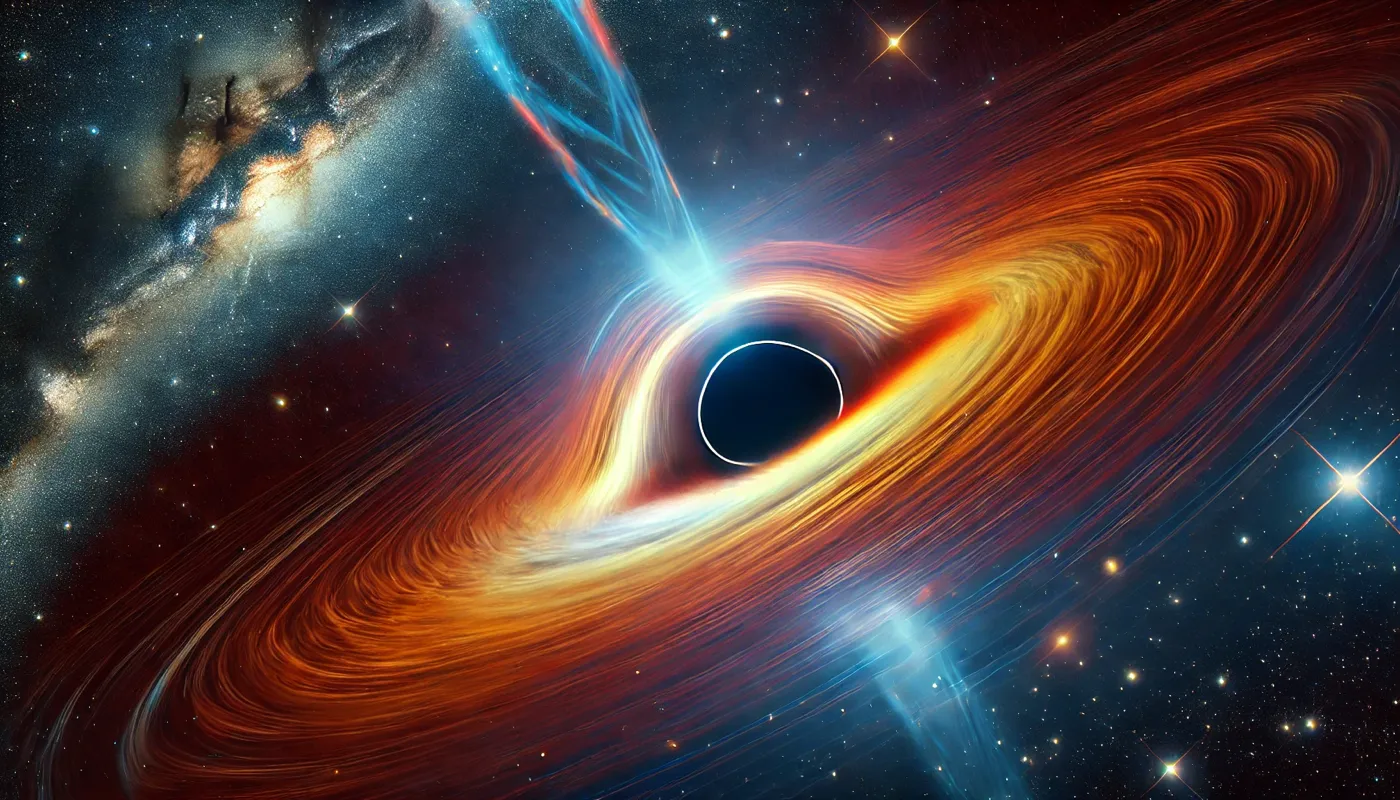
Black Holes: A Mathematical Journey Through the Event Horizon
I. Introduction
In the vastness of space, black holes stand as nature’s most extreme laboratories. These cosmic objects, where gravity reigns supreme, push our understanding of physics to its limits.
II. Formation and Basic Properties
A. Stellar Death and Collapse
When massive stars exhaust their nuclear fuel, they undergo a catastrophic collapse. For stars with mass where is the solar mass, the gravitational force overwhelms all other forces, leading to the formation of a black hole.
B. The Event Horizon
The defining feature of a black hole is its event horizon, characterized by the Schwarzschild radius:
where:
- is the gravitational constant
- is the mass of the black hole
- is the speed of light
III. Spacetime Properties
A. Metric Description
The spacetime around a non-rotating black hole is described by the Schwarzschild metric:
B. Time Dilation
An object approaching the event horizon experiences extreme time dilation, given by:
IV. Physical Effects
A. Tidal Forces
Objects approaching a black hole experience tidal forces described by:
where is the height of the object.
B. Gravitational Redshift
Light escaping from near a black hole experiences a redshift factor:
V. Quantum Effects
A. Hawking Radiation
Black holes emit thermal radiation with temperature:
where:
- is the reduced Planck constant
- is the Boltzmann constant
B. Black Hole Entropy
The entropy of a black hole, known as Bekenstein-Hawking entropy:
where is the surface area of the event horizon.
VI. Advanced Concepts
A. Angular Momentum
For rotating black holes (Kerr solution), the metric becomes more complex, introducing frame dragging effects. The angular momentum parameter must satisfy:
B. Electric Charge
Charged black holes (Reissner-Nordström solution) have an additional term in their metric related to charge :
VII. Open Questions
A. Information Paradox
The apparent loss of information in black hole evaporation leads to the equation:
where the evolution of this total entropy remains a subject of debate.
B. Firewall Paradox
The conflict between quantum entanglement and the equivalence principle, represented by the inconsistency:
where represents entanglement entropy between different regions near the horizon.
References
- Hawking, S. W. (1975). Particle creation by black holes. Communications in Mathematical Physics, 43(3), 199-220.
- Bekenstein, J. D. (1973). Black holes and entropy. Physical Review D, 7(8), 2333.
- Almheiri, A., Marolf, D., Polchinski, J., & Sully, J. (2013). Black holes: complementarity or firewalls? Journal of High Energy Physics, 2013(2), 1-20.
Notes on Mathematical Notation
All equations in this document use LaTeX notation. The equations are delimited by double dollar signs ($$) for both inline and display mathematics. Key symbols used:
- : Solar mass
- : Gravitational constant
- : Speed of light
- : Reduced Planck constant
- : Boltzmann constant
- : Vacuum permittivity
Document Information
- Author: Mustafa Ozaytac
- Date: February 9, 2025
- Version: 1.0
